Last Updated on March 5, 2026 by Vlad
There’s something that stops me every single time I’m in Japan during cherry blossom season. It’s not just the colour or the sheer volume of blooms. It’s the feeling that you’re standing inside something much older and heavier than a pretty spring day.
The cherry blossom has been Japan’s most loaded symbol for over a thousand years. And nobody understood that weight more than the samurai.
For nearly 700 years, the warrior class ruled Japan. These were men (and occasionally women) who trained to kill, lived under strict codes of honour, and faced death as a daily reality. You’d expect their favourite symbol to be something fierce. An eagle. A tiger. A sword.
Instead, they chose a flower that blooms for about two weeks and then disappears.
That’s not a coincidence. That’s a philosophy.
Mono no Aware: The Japanese Art of Loving What Doesn’t Last
Before we get into samurai and sakura specifically, you need to understand a concept that sits at the heart of Japanese culture: mono no aware. It’s one of the reasons cherry blossoms carry so much cultural weight in Japan, something I dig into more in my guide to the cultural significance of sakura.
It roughly translates to “the pathos of things” or “the bittersweet awareness of impermanence.” It’s the feeling you get when something is beautiful because you know it won’t last.
Think about the last time you watched a sunset and felt a small ache because it was ending. That’s mono no aware.
For most people, impermanence is uncomfortable. We fight it. We take photos so we can hold onto moments. We mourn things passing.
Japanese culture, particularly samurai culture, flipped this idea on its head. Impermanence isn’t something to resist. It’s the whole point. The cherry blossom is beautiful because it falls. Not despite it.
Samurai lived with death every single day. They trained for it. They wrote about it. They made peace with it in ways that most of us never have to. Mono no aware wasn’t a poetic concept for them. It was lived experience.
No wonder they loved cherry blossoms.
“Fall Like Cherry Petals”: The Samurai Ideal of a Good Death
There’s a proverb that cuts right to the core of this connection:
“The cherry blossom is first among flowers, the warrior is first among men.”
This wasn’t just flattery. It was a statement of values.
The ideal samurai death was to fall at the peak, like a blossom dropping from a branch in full bloom. Not to wither slowly. Not to grow old and weak and irrelevant. To burn bright and fall clean.
Dying in battle, in service to your lord, at the height of your power? That was considered honourable and beautiful. A good death.
The falling petal became a symbol of exactly that. Every spring, when the blossoms dropped, samurai were reminded of what they were training for and what they were willing to give.
It sounds bleak when you write it out in plain English. But spend enough time in Japan, watching petals fall into a river or drift across a temple courtyard, and you start to understand why this idea had such grip.
Samurai on the Battlefield: Cherry Blossoms in the Heat of War
The Tale of the Heike and the Battle of Ichi-no-Tani (1184)
One of Japan’s greatest literary works, The Tale of the Heike (I recommend you read it, especially the version translated by Helen Craig McCullough), chronicles the brutal Genpei War between the Taira and Minamoto clans. It’s full of warriors doing something that seems strange to modern readers: stopping before battle to compose poetry.
Not as a delaying tactic. As a ritual.
Samurai in this era were expected to be both fighters and artists. Writing a poem before battle, often referencing cherry blossoms or falling petals, was a way of acknowledging what was about to happen. A kind of conscious goodbye to the world.
The ideal warrior of this period wasn’t just deadly. He was refined. Courtly culture and martial culture weren’t opposites. They fed each other. Cherry blossoms sat right at the intersection.
Cherry Blossom Crests, Armour, and Weapons
This wasn’t just poetic symbolism. It showed up in physical gear samurai wore and carried.
I actually had this click for me in a samurai museum in Asakusa. I was moving through the armour and sword displays, just taking it all in, when I started noticing sakura patterns everywhere. On helmets. On sword guards. Stitched into fabric. Carved into metal. Once I saw it the first time I couldn’t unsee it, and it stuck with me long after I left. These were warriors built for violence, and they surrounded themselves with cherry blossoms. That contrast is what sent me down the rabbit hole that eventually became this article.
- Kabuto (helmets) were decorated with cherry blossom motifs, sometimes in gold or lacquer
- Tsuba (sword hand guard) featured intricate sakura inlay work, turning a functional piece of metal into a work of art
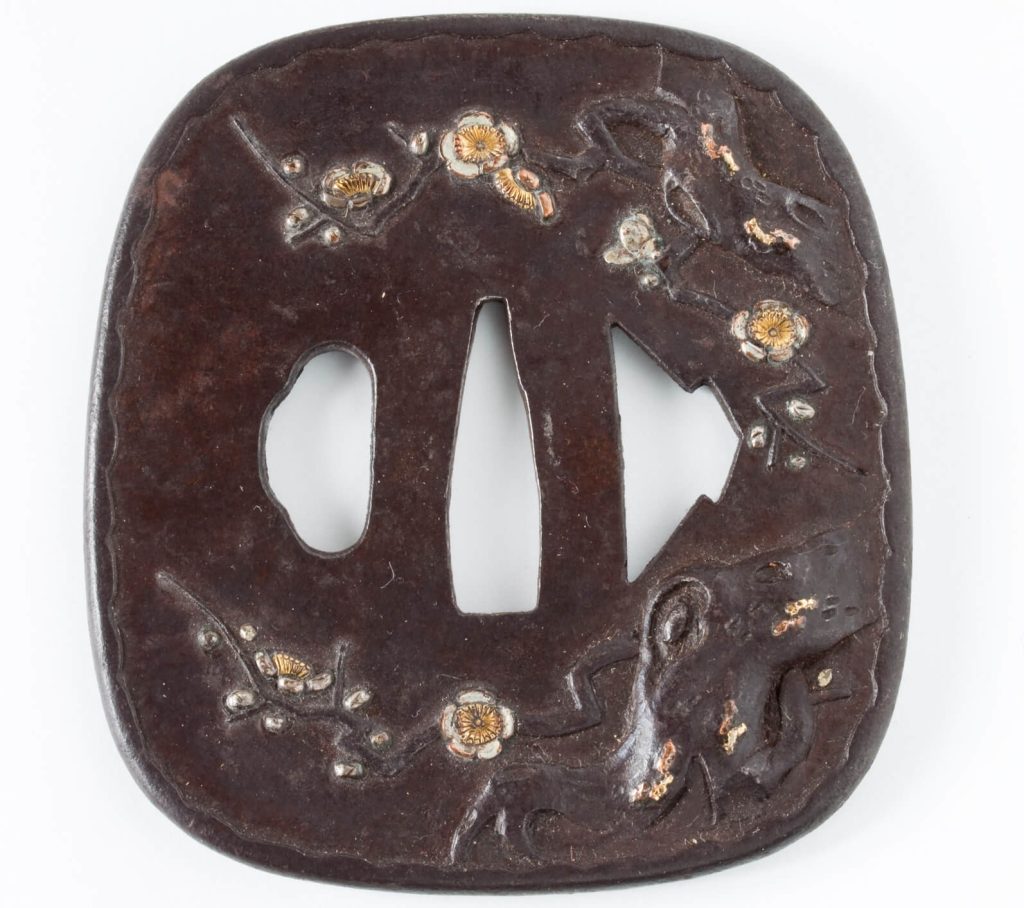
- Mon (family crests) belonging to various samurai clans incorporated cherry blossoms as their symbol
- Clothing and armour fabrics were often decorated with sakura patterns
Every time a samurai looked at his sword guard or touched his helmet, he was seeing that reminder. Beauty. Impermanence. The willingness to fall.
Famous Samurai Who Loved Cherry Blossoms
Three names stand out when it comes to the samurai-sakura connection. If you want the full story on these warriors, check out my guide to Japan’s most iconic samurai. But here’s how each of them connects to cherry blossoms specifically.
Minamoto no Yoshitsune: Japan’s Most Legendary Warrior
If you know one name from samurai history, it’s probably Yoshitsune. He’s essentially Japan’s King Arthur, a brilliant military commander whose story has been told and retold for 800 years.
Yoshitsune is closely connected to Yoshino, a mountain region in Nara Prefecture that remains one of Japan’s most famous cherry blossom spots to this day. Poems attributed to him reflect on the blossoms there, and the association between his tragic, short life and the fleeting beauty of sakura has cemented his place in Japanese cultural memory.
His story, like the cherry blossom, ends too soon. That’s probably not an accident.
Oda Nobunaga: Warlord, Unifier, and Sakura Fan

Nobunaga is one of the most fascinating and terrifying figures in Japanese history. He came closer than anyone before him to unifying a fractured, war-torn Japan, and he did it through sheer ruthlessness and tactical genius.
He’s also reported to have danced at hanami parties and was known to reflect on the line: “Life is but fifty years.”
That sentiment, that life is brief, that power is fleeting, echoes directly with cherry blossom philosophy. Even for a man who controlled half of Japan, the petals fell the same way they fell for everyone else.
He was assassinated in 1582, at the height of his power. Falling at the peak.
Saigo Takamori: The Last Samurai
If Nobunaga is the ruthless pragmatist, Saigo Takamori is the romantic. He’s often called the last true samurai, a military leader who fought to preserve the samurai way of life during the Meiji Restoration in the late 1800s.
He loved cherry blossoms. His poems compare his life and his cause to falling petals, beautiful and brief, dying in service to something greater than himself.
He led a doomed rebellion in 1877, was wounded in the final battle at Shiroyama, and reportedly asked a companion to end his life before he could be captured.
Falling like a cherry blossom. Not withering on the vine.
Samurai Poetry About Cherry Blossoms
Warrior poetry about sakura is everywhere in Japanese literature. A few translated examples give you a sense of the tone:
The 12th-century warrior-poet Taira no Tadanori (who died at the Battle of Ichi-no-Tani) wrote about returning home to see the cherry blossoms again, knowing he might not make it back. The poem is tender and resigned, completely at odds with the image of a battle-hardened samurai, and yet entirely consistent with samurai culture.
The tradition of jisei, or death poems written in the final moments of life, often referenced cherry blossoms. These weren’t morbid. They were meditative. A last look at the world, finding it beautiful even as you left it.
Even the great haiku master Matsuo Basho, who lived during the samurai era and was deeply influenced by Zen philosophy, wrote repeatedly about cherry blossoms and the ache of things passing:
“Many things of the past / are brought to my mind / as cherry blossoms”
It’s a line that could have come from any samurai journal of the period. The connection between memory, beauty, and loss is the same.
The Dark Side: When Sakura Became a Tool of War
This is worth being honest about, because the samurai-sakura connection has a complicated legacy.
During the Meiji era and into the 20th century, the Japanese military co-opted cherry blossom symbolism in ways that went well beyond poetry and philosophy.
- Soldiers were told to “fall like cherry blossoms” for the emperor
- Kamikaze pilots painted sakura on their aircraft
- Cherry blossoms appeared on military insignia and propaganda
- The “beautiful death” philosophy was used to justify enormous sacrifice
This was a deliberate distortion of something much older and more nuanced. The samurai ideal of a good death was about individual honour within a code. The 20th-century military version stripped out the philosophical depth and turned it into a recruitment tool.
When you visit Japan and see cherry blossoms today, that history is in there too. Japanese people are largely aware of it, and it adds another layer to what is already a layered symbol.
Understanding this doesn’t make hanami less joyful. If anything, knowing the full weight of the symbol makes those few weeks feel even more precious.
Samurai Films and Sakura: How Cinema Keeps the Connection Alive
Japanese cinema has understood this connection for decades.
- Seven Samurai (1954): Kurosawa uses sakura and seasonal imagery to underscore the melancholy of his warriors’ situation
- Ran (1985): Kurosawa again, with cherry blossoms appearing at pivotal moments of beauty and devastation
- Twilight Samurai (2002): A quieter film, but the sakura imagery reinforces the main character’s awareness of his own fading world
Modern anime, manga, and martial arts culture continue to use the cherry blossom as shorthand for a whole philosophy. When you see sakura in a samurai film, you’re not just seeing a pretty tree. You’re seeing 1,000 years of meaning compressed into a single image.
Japanese martial arts schools (dojo) frequently use the sakura as their symbol. The connection isn’t nostalgic. It’s still alive.
Why This Matters When You’re Standing Under a Sakura Tree
Here’s the thing I always try to remember when I’m doing hanami in Japan.
The people sitting under those trees with their bento boxes and their beers? Their culture has been looking at cherry blossoms for over a thousand years. Poets wrote about them. Warriors died with them in mind. Philosophers built entire frameworks around what those petals mean.
You don’t need to know all of that to enjoy hanami. But knowing it does something to the experience. And if you’re heading to Japan this season, make sure you know when peak bloom is forecast for wherever you’re visiting, timing really does make or break it.
The next time you see petals falling, think about mono no aware. Think about the idea that something is more beautiful because it doesn’t last. Think about people who faced death daily and found comfort in a flower that did the same thing every year, fell without resistance, and came back again in spring.
That’s not just a pretty flower. That’s a whole way of being in the world.
And for two weeks every year, Japan stops what it’s doing and sits with that.
Worth joining in, if you ask me. Just make sure you brush up on hanami etiquette before you unroll that picnic mat.
Samurai and Cherry Blossoms Questions & Answers
Why did samurai love cherry blossoms?
Samurai connected deeply with cherry blossoms because of what they represented: beauty that doesn’t last. Petals fall at their peak, which mirrored the samurai ideal of dying honourably in battle rather than fading with old age. The philosophical concept of mono no aware, finding beauty in impermanence, was central to samurai culture.
What do cherry blossoms symbolise in Japanese culture?
Cherry blossoms symbolise impermanence, renewal, and the bittersweet beauty of things that don’t last. In samurai culture specifically, they represented a good death and the ideal of living fully in the moment. Today they still carry those layers of meaning, even during casual hanami picnics.
What is mono no aware?
Mono no aware is a Japanese concept that roughly translates to “the pathos of things.” It describes the tender, bittersweet feeling that comes from knowing something beautiful won’t last. Cherry blossoms are considered the perfect symbol of mono no aware because they bloom brilliantly for only a couple of weeks before falling.
Did samurai actually use cherry blossom symbols on their armour?
Yes. Cherry blossom motifs appeared on helmets (kabuto), sword guards (tsuba), family crests (mon), and clothing. For a samurai, wearing or carrying that symbol was a daily reminder of beauty, mortality, and what they were prepared to give. You are guaranteed to see some if you visit a samurai museum.
Why did kamikaze pilots use cherry blossom imagery?
The Meiji-era military and later the wartime government deliberately co-opted the older samurai connection between cherry blossoms and honourable death. Pilots were told to “fall like cherry blossoms” for the emperor, and sakura were painted on aircraft. It was a calculated use of a centuries-old symbol, and a much darker application than the philosophical samurai tradition it drew from.
Which samurai are most associated with cherry blossoms?
Minamoto no Yoshitsune is closely linked to the famous cherry trees at Yoshino in Nara. Oda Nobunaga was known to reflect on the brevity of life during hanami. Saigo Takamori, often called the last samurai, wrote poems comparing his life and death to falling petals. All three lived short, intense lives that ended at or near their peak.
Can you still see samurai cherry blossom connections in Japan today?
Absolutely. Many castles and samurai sites are planted with cherry trees, partly for this reason. Hirosaki Castle, Himeji Castle, and Matsumoto Castle all have famous sakura. Japanese martial arts schools still use the cherry blossom as a symbol. And samurai-era poetry and death poems referencing sakura are still read and studied across Japan.
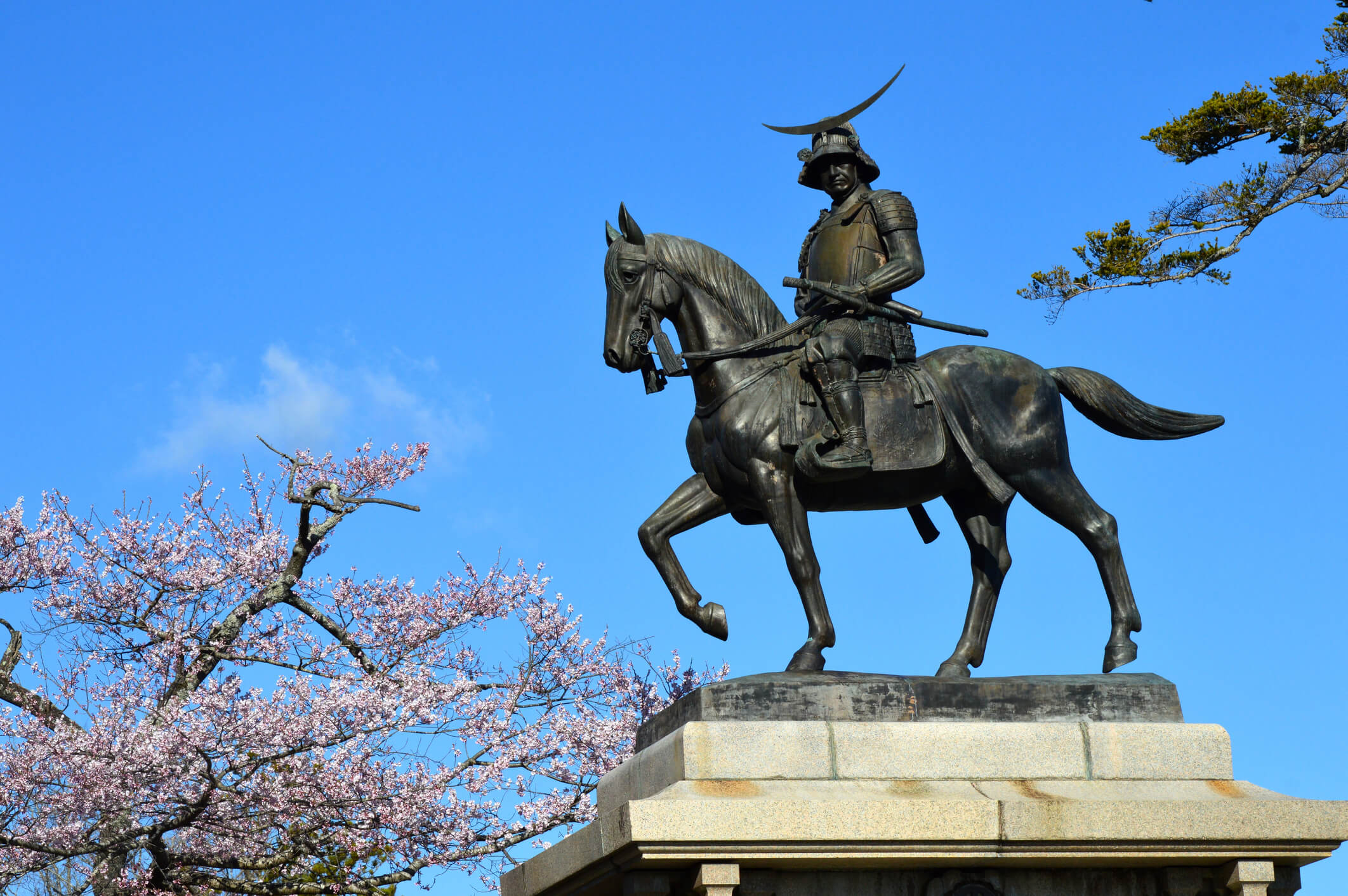
The cover image I have used for this posts shows you this connection perfectly – a statue of a famous samurai – Date Masamune with Cherry Blossoms at Aoba Castle Park, in Sendai.
Plan Your Cherry Blossom Trip
- 📖 The Cultural Significance of Sakura in Japan – Go deeper on what cherry blossoms mean to Japanese culture
- 🌸 Japan Cherry Blossom Forecast 2026 – When and where to catch peak bloom
- 🧺 Hanami Etiquette: How to Do It Right – Don’t be that tourist
- ⚔️ Japan’s Most Iconic Samurai Warriors – Meet the men behind the legend