Last Updated on April 16, 2026 by Vlad
15–17 May 2026 | Asakusa, Tokyo | Free entry
Two million people. A hundred portable shrines. Taiko drums you can feel in your chest. And a crowd that’s about as local as Tokyo gets.
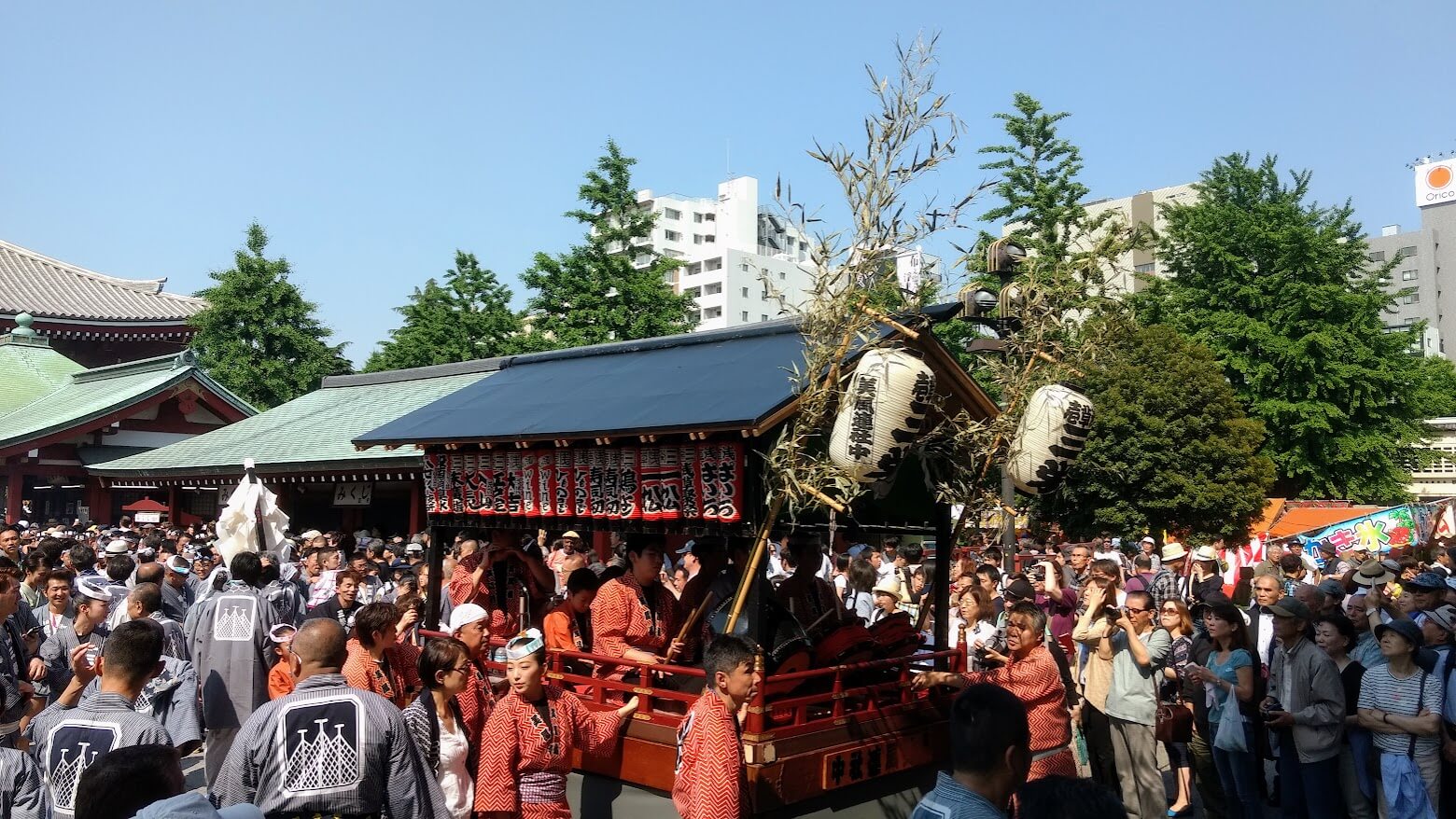
Sanja Matsuri is held every May in Asakusa, and it’s unlike any other festival in Japan. It’s loud, it’s physical, and it’s electric. I went for the first time in 2017 with no real idea of what I was walking into, and within minutes of arriving I was completely swept up in it. What struck me most wasn’t the scale, it was how domestic the crowd felt and the energy. This wasn’t a spectacle dressed up for tourists. It was a real local celebration, and we’d just turned up in time to witness it.
If you’re in Tokyo this May, here’s everything you need to make the most of it.
What Is Sanja Matsuri?
Sanja Matsuri (三社祭) is one of Tokyo’s three great Shinto festivals. It honours the three men who founded Sensoji Temple: fishermen brothers Hinokuma Hamanari and Hinokuma Takenari, who pulled a small Kannon statue from the Sumida River in 628 AD, and Hajino Nakatomo, a local landlord who helped consecrate it.
It’s an unusual cross-faith celebration: a Shinto festival dedicated to the spirits of three men who founded a Buddhist temple.
If you’re into Japanese history and want to dig deeper into the culture behind festivals like this one, there’s plenty more to explore in the History and Culture section.
The centrepiece of the whole weekend is the mikoshi, portable shrines carried through the streets by neighbourhood teams. More on those below.
Which Day Should You Go?
This is the question that actually matters. Here’s the breakdown:
Friday: The parade day The most accessible and least overwhelming. A grand procession winds through Asakusa in the afternoon. Good for photos, much easier to move around. If crowds stress you out, Friday is your day.
Saturday: The neighbourhood mikoshi day My pick. Around 100 mikoshi are carried out of Asakusa Shrine, blessed, then paraded back through the Sensoji grounds and out through Kaminarimon gate by neighbourhood teams, starting around noon. The event runs for hours, and the crowd intensity builds as the afternoon goes on. There’s also a shrine maiden dance at 17:00.
Sunday: The main event The three principal mikoshi of Asakusa Shrine, representing the spirits of the three founders, are carried through all 44 districts of the neighbourhood. It’s the most significant day, the loudest day, and the most crowded day. Traffic restrictions apply, and if you want a good viewing spot you’ll need to arrive early and make sense of the route maps on the official website (check the Japanese version too, as it’s much better)
Sunday is also the day you’re most likely to spot yakuza members showing off elaborate full-body tattoos in the backstreets. It’s controversial, but it’s part of Sanja Matsuri’s reputation, and pretending otherwise wouldn’t be honest.
Bottom line: Go Saturday if you can only pick one. Go Sunday if you want the full spectacle and don’t mind serious crowds. Go Friday if you want the festival without the chaos.
What Actually Happens: Understanding the Mikoshi
If you’ve never been to a mikoshi procession, here’s what you need to know.
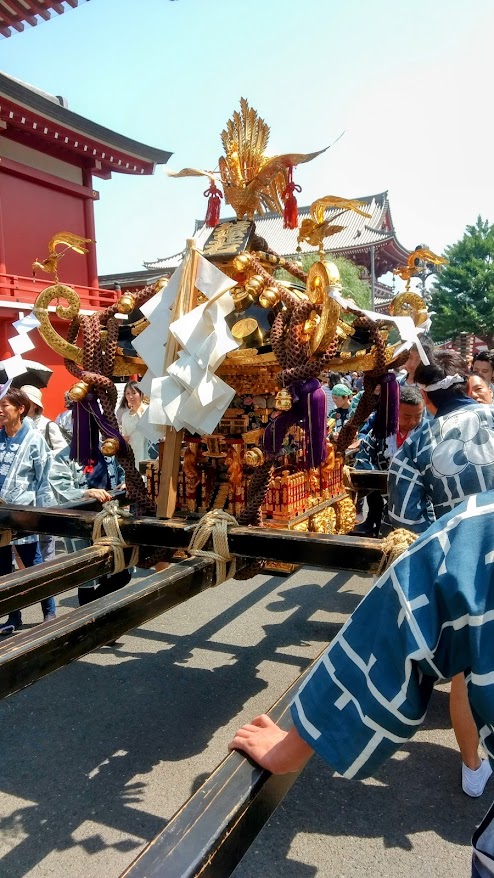
A mikoshi is a portable shrine, an ornate, heavily gilded miniature structure mounted on long wooden poles. Each one can weigh hundreds of kilograms and is carried by a team of neighbourhood residents in matching happi coats. They chant, they bounce the shrine rhythmically, and they push through the streets with complete intensity.
The festival is known for “Tamafuri” (soul-shaking), where the portable shrines are bounced violently to rouse the spirit of the deity inside. When you’re standing close enough to feel the weight of the thing and a hundred people are chanting in unison, it’s genuinely overwhelming in the best way.
Participants sometimes ride on top of the mikoshi and try to knock opponents off, even though this is strictly prohibited. It happens every year anyway. The officials frown. The crowd cheers. If lucky you might be able to see it.
Some of the Saturday mikoshi are carried entirely by women or small children, which is worth watching for. The contrast between a team of serious adults absolutely going for it and a group of kids proudly hauling their little shrine is one of the best things about the day.
Here’s a clip I shot at Sanja Matsuri back in 2017 – this is a neighbourhood team just getting their mikoshi moving through the crowd.
Full 2026 Schedule
Friday 15 May
| Time | Event |
|---|---|
| 13:00 | Grand parade (Daigyoretsu) departs from north of Sensoji |
| 14:20 | Special dance performance at Asakusa Shrine |
The grand parade features people in historical costumes walking through the streets of Asakusa. More stately than Saturday and Sunday, which makes it a good introduction to the festival if you’re arriving early in the weekend.
Saturday 16 May
| Time | Event |
|---|---|
| From 12:00 | ~100 neighbourhood mikoshi parade from Asakusa Shrine |
| 13:00–15:00 | Geisha performance at Asakusa Kenban (ticketed) |
| 17:00 | Shrine maiden dance at Asakusa Shrine |
Sunday 17 May
| Time | Event |
|---|---|
| 07:00 onwards | Three sacred mikoshi carried through all 44 districts |
| 13:00–15:00 | Geisha performance at Asakusa Kenban (ticketed) |
| 14:00–16:00 | Taiko drum performance at Asakusa Shrine (free) |
For the most up-to-date event details and any schedule changes, check the official Asakusa Shrine website.
The Geisha Performances
On Saturday and Sunday afternoons, geisha perform at the Asakusa Kenban, a traditional geisha house. These ticketed performances have been ranked among the top 10 geisha shows in Japan.
Worth considering if you’ve never seen a geisha performance. The Sanja Matsuri setting adds something you won’t get at a standard tourist-facing show. Book ahead, as it sells out.
On Sunday afternoon, the Nihon Taiko Dojo performs a free half-hour taiko show at Asakusa Shrine. Arrive early to get a spot.
Practical Tips
When to arrive
Earlier than you think. By mid-morning on Saturday and Sunday, Asakusa is already filling up. For Sunday’s opening procession, aim to be there by 7:30 am if you want any breathing room. Otherwise be prepared to walk through massive crowds.
Where to stand
The spot near Kaminarimon gate is hard to beat. Watching a full mikoshi team come through that gate is one of those moments that sticks with you. Get there early, plant yourself, and be patient (seriously, patience is the key). See the map below for exactly where to find it.
What to bring
- Cash. The food stalls are almost entirely cash-only.
- Comfortable shoes. You’ll be on your feet for hours.
- A light layer. Mid-May in Tokyo can turn cool by evening. Check the forecast.
- A fully charged phone. You’ll take more photos than you expect.
Getting there
The closest stations are Asakusa on the Tokyo Metro Ginza Line, Toei Asakusa Line, or Tobu Skytree Line. On Sunday especially, expect the trains to be packed. Try to avoid the rush around the stations by heading out early.
Language
If you’re worried about getting around Japan without speaking Japanese, it’s much more manageable than most people expect. This guide covers exactly that, including how to handle festival situations where things get loud and chaotic.
A note on behaviour
Sanja Matsuri is a real local festival, not a performance for tourists. Stay out of the path of the mikoshi bearers when they’re moving, don’t push to the front when teams are in motion, and read the room. The welcome is genuinely warm if you approach it with respect. Behave like the locals and enjoy!
Food and Drink
Half the fun is just wandering around eating. Food stalls are set up throughout the surrounding area for the entire weekend.
Look for:
- Yakitori – skewered chicken grilled over charcoal
- Takoyaki – octopus balls, well worth the queue
- Taiyaki – sweet, fish-shaped cakes filled with red bean paste or custard. If you haven’t tried one before, a busy festival weekend is the perfect opportunity.
- Kakigori – shaved ice with flavoured syrup, perfect if the weather is warm
- Cold canned beer and chu-hi from nearby convenience stores if the stall queues get too long
The Nakamise shopping street leading up to Sensoji is lined with vendors too, though it’ll be busier than usual. Good for a browse, less good if you’re hungry and impatient.
While You’re in Asakusa
Since you’re already there, it’s worth knowing what else is close by:
- Sensoji Temple – right next to the shrine, and one of Tokyo’s most photographed spots. Worth a slow walk through even during festival weekend.
- Tokyo Skytree – a 10-minute walk or one train stop. Views across the entire city.
- Kappabashi Kitchen Street – a 10-minute walk west. Japan’s best street for ceramic bowls, proper knives, and those absurdly realistic plastic food display models. A place where I bought a ceramic rice cooker which still makes the best rice 15 years later.
Sanja Matsuri is also one of the best free experiences in Tokyo. If you’re building a trip around not spending a fortune, there’s a full list of free things to do in Tokyo worth bookmarking before you go.
Quick Reference
| Dates | Friday 15 – Sunday 17 May 2026 |
| Location | Asakusa Shrine, Asakusa, Tokyo |
| Entry | Free |
| Nearest station | Asakusa (Ginza Line / Asakusa Line / Tobu Skytree Line) |
| Best day | Saturday for atmosphere, Sunday for scale |
| Don’t miss | Mikoshi through Kaminarimon, Sunday taiko (free), food stalls all weekend |
| Book ahead | Geisha performances at Asakusa Kenban |
| Official website | asakusajinja.jp |