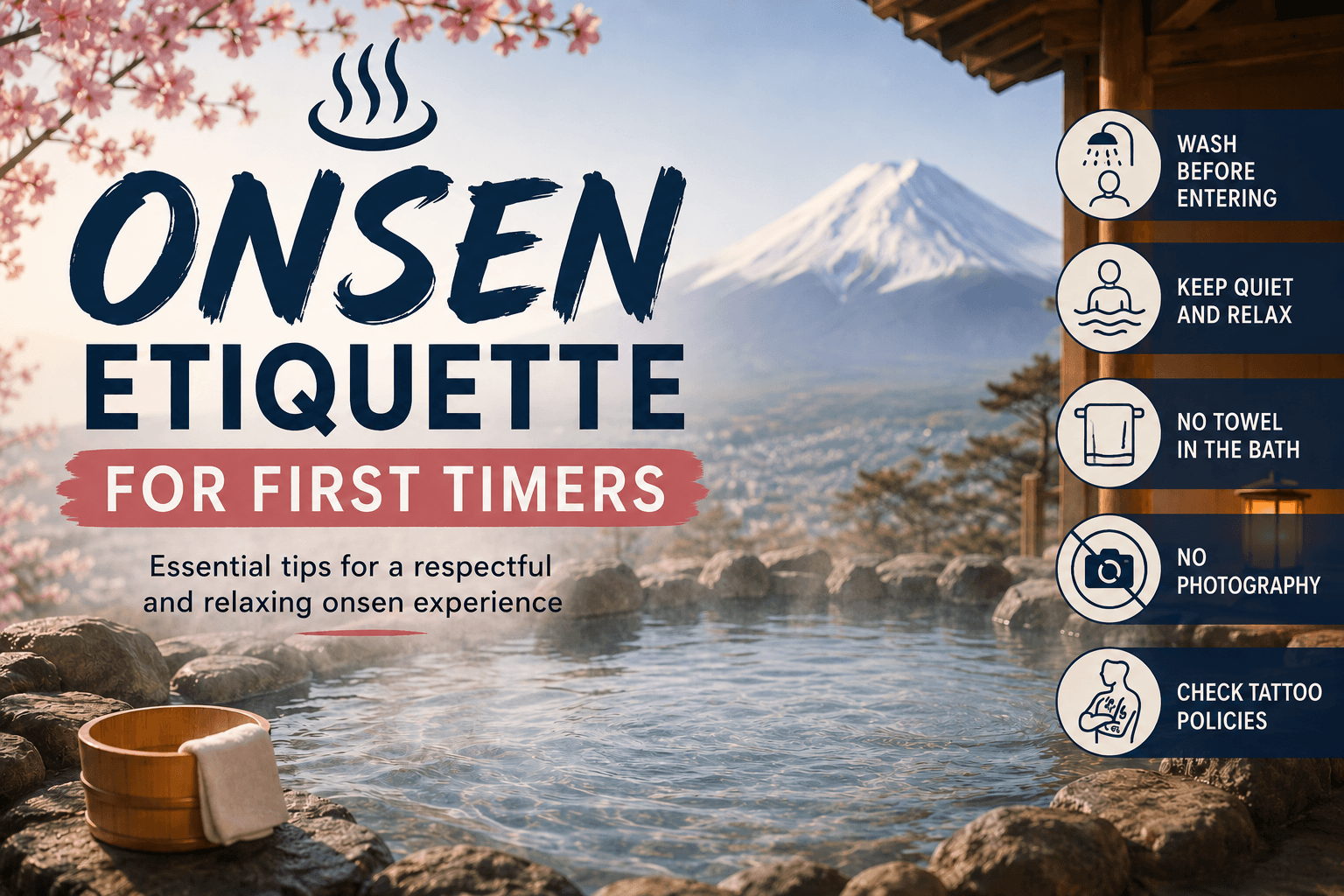
Last Updated on May 26, 2026 by Vlad
There are unwritten rules at Japanese hot springs. Break them and you’ll get the look. (You know the one.)
I’ve been visiting Japan since 2004, but it took me many years to even try an onsen. The thought of getting naked in front of strangers had me politely declining for years. When I finally did take the plunge, mostly during solo trips and visits with friends, I made every rookie mistake going. I dropped my little towel in the water. I dunked my head under (multiple times). I once turned up after more than a couple of beers and nearly floated out feet-first. The lot.
Years later, my wife, patiently walked me through everything I’d been doing wrong. I was a slow learner.
It all finally clicked in 2018, at a ryokan down on the Izu Peninsula. I had the outdoor onsen entirely to myself (sheer luck I guess), looking up at a sky absolutely crammed with stars. The whole thing felt surreal and somehow ridiculously simple at the same time, refreshing and recharging in equal measure. I sat there thinking, I could do this for the rest of my life. That’s where I fell in love with onsen, and with the etiquette. It only took me fourteen years.
Simple rules, maximum enjoyment. The price of admission to one of the most peaceful experiences on the planet.
These days, we’re a proper onsen family. My wife grew up loving them, I’m a convert who’s now feeling like a pro, and our nearly six-year-old can show you exactly where the small towel goes (on your head, not in the water, thank you very much).
So this is the guide I wish I’d had years ago. No shame, no judgement, just the etiquette you need to walk in confident and walk out blissed out.
Onsen Etiquette Rules at a Glance
Save this. Screenshot it. Pin it. The whole etiquette guide in one quick reference:
| Rule | OK? |
|---|---|
| Wash thoroughly before entering the bath | ✅ Yes, always |
| Swimsuit or underwear in the water | ❌ Never |
| Small towel in the water | ❌ Never |
| Long hair touching the water | ❌ Tie it up |
| Phones or photos | ❌ Never |
| Loud voices | ❌ Keep it quiet |
| Running, splashing, swimming laps | ❌ Never |
| Dunking your head under | ❌ Keep it above water |
| Alcohol before bathing | ❌ Save it for after |
| Tattoos | ⚠️ Sometimes (check the rules) |
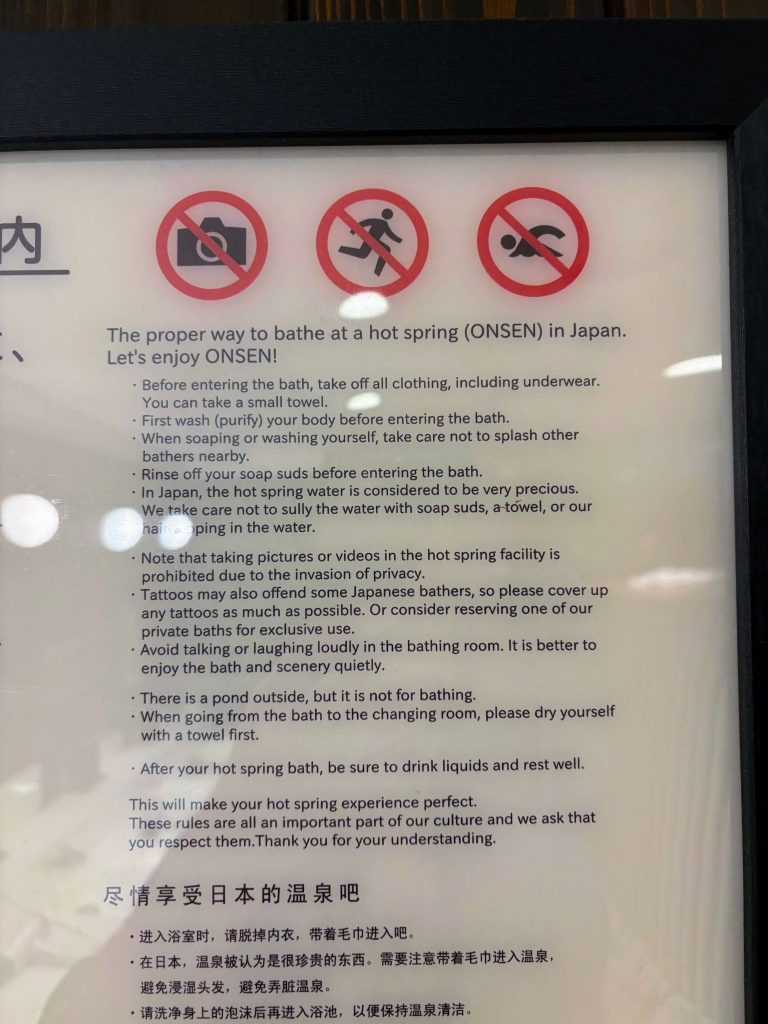
The rest of this guide walks you through each one with context, plus everything else you need to know.
What is an Onsen? (Quick Definition)
Quick lesson before we get into the rules:
- Onsen (温泉): Natural hot spring water, legally defined in Japan by mineral content and temperature. The proper stuff.
- Sento (銭湯): Public bathhouse, usually heated tap water. Same etiquette applies.
- Rotenburo (露天風呂): Outdoor onsen, often the most beautiful (and gloriously freezing around the edges in winter).
- Konyoku (混浴): Mixed-gender bathing. Rare these days.
- Kashikiri-buro (貸切風呂): Private bath you can book. Brilliant for families and tattoo-having travellers.
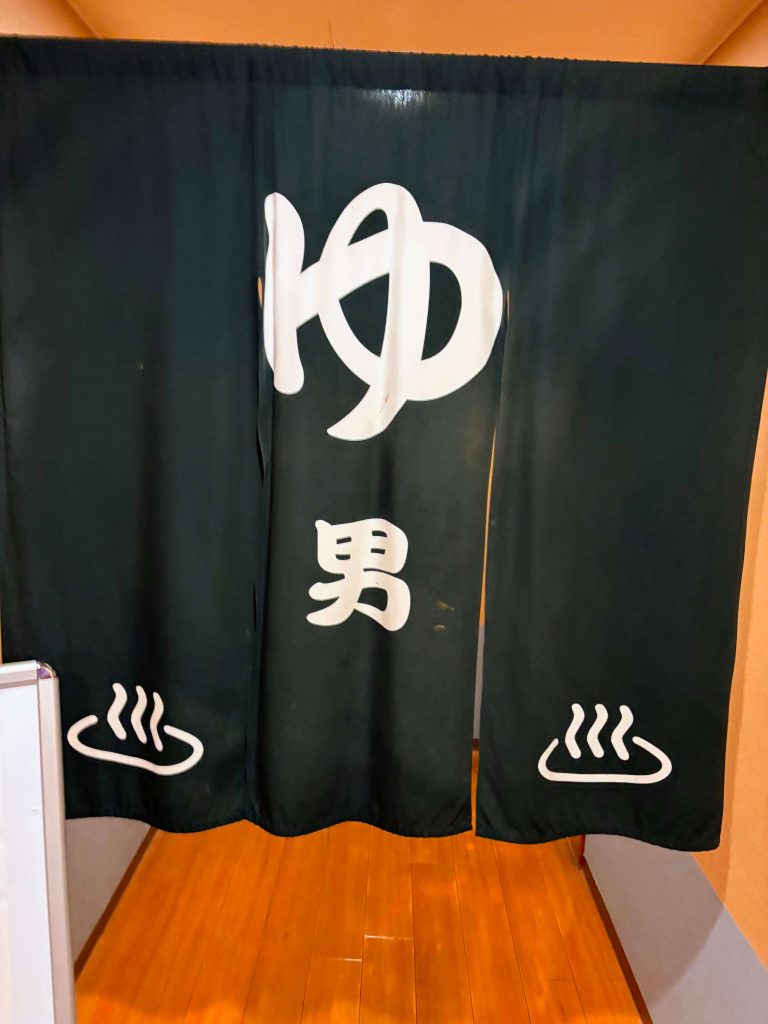
Most onsen are split by gender. Blue (or dark navy blue) curtain for men (男), red for women (女). Memorise those two characters before you go in. You really don’t want to learn the difference the hard way.
Types of Onsen You’ll Come Across
Not all onsen are the same experience. Knowing the difference helps you pick what suits your travel style.
- Ryokan onsen: Traditional Japanese inns with on-site baths. Often include kaiseki dinner and breakfast. The full bucket-list experience. Some have private in-room baths (huge if you’ve got tattoos or kids).
- Day onsen (higaeri): Visit just for the bath, no overnight stay. Cheap, flexible, ideal for first-timers who want low commitment.
- Super sento: Massive modern bathing complexes with multiple pools, saunas, restaurants, sometimes even theme park vibes. Great for families. Yunessun in Hakone is a famous example.
- Mountain onsen: Secluded, often historic, sometimes hard to get to, almost always worth it. Think Nyuto Onsen in Akita or Kurokawa in Kyushu.
- Hotel onsen: Western-style hotels with onsen facilities downstairs. Convenient but less atmospheric.
- Public sento: Local neighbourhood bathhouses. Heated tap water, not technically onsen, but the etiquette is identical and they’re a brilliant slice of everyday Japanese life.
- Ashiyu (foot baths): Free, clothed, public. You’ll spot them in onsen towns like Atami and Kusatsu. A nice gateway if you’re nervous about the full experience.
If you’re a complete onsen beginner, I’d start with either a private kashikiri-buro at a ryokan or a relaxed day onsen. Massive resort baths can be intimidating on day one.
The 7 Essential Onsen Rules
1. Wash thoroughly BEFORE entering the bath
This is the big one. You wash yourself completely before you touch the communal water. Sit on the little stool at the washing area, grab the showerhead, soap up, shampoo, rinse properly. Twice if needed. The bath isn’t where you get clean. It’s where you go after you’re already clean.
2. No swimsuits (yes, really naked)
I know. Took me years to get past this. But everyone is naked, no one is looking, and after about ninety seconds you genuinely stop caring. Swimsuits introduce detergent residue to the water and aren’t allowed in nearly all proper onsen.
3. Long hair must be tied up
Bring a hair tie. If your hair touches the water, that’s a faux pas. Most onsen have free ties at the entrance, but I’d bring your own to be safe.
4. The small towel doesn’t go in the water
This was my old enemy. You get two towels: a big one (stays in the changing room for drying off) and a small one (comes with you for modesty). The small towel does NOT enter the bath. Pop it on the rocks, fold it on the side, or balance it on top of your head. Very Japanese.
5. No phones, no photos, ever
Don’t even bring your phone in. Lockers exist for a reason. Photos of any kind in the bathing area are an absolute no, full stop.
6. Quiet voices (it’s not a pool party)
Onsen are relaxing spaces. Chat with your mates by all means, but keep it to a murmur. No yelling, no laughing your head off, no calling across the bath.
7. Don’t run, splash, or dunk your head
It’s not a swimming pool. No swimming, no horseplay, no diving. And definitely no putting your head under (my biggest beginner sin, repeated for far too many years).
How Hot Are Onsen? (And Why You Might Feel Faint)
Most onsen sit between 38°C and 44°C. That’s properly hot. Some are cooler “nuru-yu” baths around 36 to 38°C (lovely for kids and long soaks), and some are scorching “atsu-yu” baths up to 46°C (for the locals who’ve been doing this their whole lives).
Even at 41°C, an onsen feels significantly hotter than your shower at home. Why? Because you’re sitting in still, mineral-heavy water that holds heat against your skin. Plus, you’re staying in for ten minutes, not two.
The risk is something the Japanese call “yu-atari” (湯あたり): bath sickness. It looks like:
- Dizziness and feeling faint when you stand up
- Headache
- Nausea
- Heart racing
The fix is hydration and sensible time limits:
- Drink a big glass of water before you go in. Most onsen have a water fountain at the entrance for this exact reason.
- Soak for 5 to 10 minutes, then get out and cool off on the side.
- Rehydrate between soaks.
- Three rounds is plenty. Total time in water, 30 to 45 minutes max.
- Step out the moment you feel dizzy. Don’t tough it out.
Skip the booze beforehand
This is the mistake I made multiple times before learning. Alcohol dilates your blood vessels. Hot water dilates your blood vessels. Combine them and your blood pressure drops, you get dizzy, and you risk a proper fall.
Save the beer for after. Cold beer post-onsen is one of the great combinations in life anyway.
Step-by-Step: Your First Onsen Visit
Here’s exactly what happens, in order, so you don’t feel lost:
- Arrive and remove your shoes at the entrance. Shoe lockers are usually right there.
- Pay and grab your towels. Towels are sometimes included in the entry fee, sometimes a couple of hundred yen to hire separately.
- Head to the changing room. Find a locker, get fully undressed, put everything inside.
- Walk to the washing area with just your small towel for cover.
- Sit on the stool and wash thoroughly. Soap up, shampoo, rinse properly. Rinse the stool and bucket when you’re done.
- Enter the bath slowly. Hot water can be a shock. Ease in.
- Soak for 5 to 10 minutes, then get out, cool off, drink water.
- Go back in if you fancy. Two or three rounds is normal.
- Dry off properly with your small towel before stepping back into the changing room. Don’t drip everywhere.
Best Type of Onsen for Nervous First-Timers
If the whole naked-in-public bit is making you sweat (before you’ve even got in the water), here’s how to ease yourself in:
- Start at a ryokan if you can. This is my number one recommendation. A ryokan onsen stay is part of the whole Japan-only experience, the kind you’ll talk about for years. You can quietly watch the locals and pick up the rhythm without anyone making a thing of it. And many ryokans (not all) offer kashikiri-buro: private baths you can book just for your group, which is brilliant for nervous first-timers, tattooed travellers, and families.
- Pick a smaller ryokan over a giant tourist resort. Quieter, less intimidating, staff have more time to help you (I don’t mean in the bath)
- Go during off-peak hours. Mid-morning or mid-afternoon on a weekday is dead quiet. Avoid evenings around 6 to 8pm when locals finish work.
- Avoid major holidays. Golden Week (late April to early May), Obon (mid-August), and New Year are absolute chaos. Don’t pick those weeks for your first onsen. Check my full 2026 public holiday guide here.
- Try a day onsen if a ryokan isn’t an option. Lower commitment. If you hate it, you’ve lost an hour and a few hundred yen.
- Consider Yunessun in Hakone. It’s a swimsuit-friendly onsen theme park. Not the “real” experience, but a good gateway if you’re truly anxious about nudity.
Once you’ve done it once, that’s it. The fear is gone forever. Promise.
Onsen Etiquette for Foreigners
Quick reassurance, because I needed this myself in the early days: Japanese people do not expect foreigners to nail every rule perfectly.
What they do expect is:
- Genuine effort. If you’re trying to do the right thing, that’s noticed and highly appreciated.
- Quiet respect. Onsen are sacred, calm spaces. The single most important rule isn’t on any list. It’s just to be considerate of the people around you.
- Watch and copy. If you’re unsure, see what the locals are doing and follow their lead.
If you make a small mistake, no one is going to chase you out. Someone might gently let you know, or staff might quietly correct you. Apologise (sumimasen works), don’t repeat it, and carry on. That’s the whole game.
The biggest thing foreigners get wrong isn’t a specific rule. It’s treating the onsen like a casual swimming experience, or thinking that the whole place belongs only to them (sorry, it doesn’t unless its a private one). The shift in mindset to “this is a quiet, almost meditative ritual” sorts most of it out.
Onsen and Tattoos in 2026
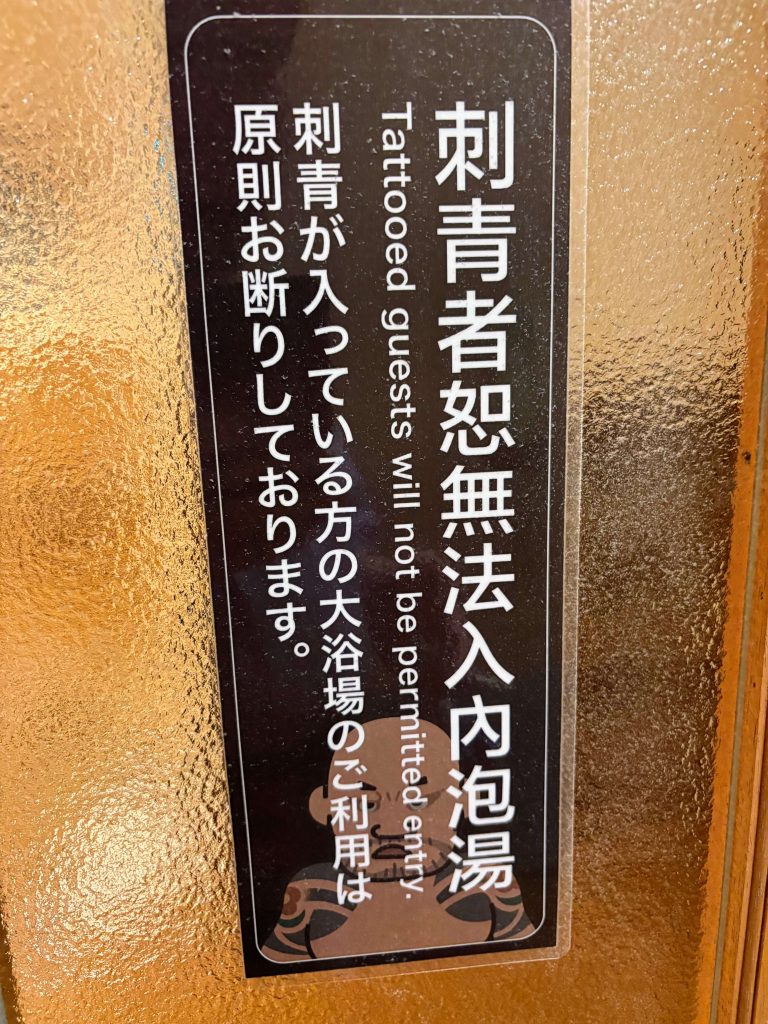
The most-asked question from many foreign travellers, so let’s cover it properly.
Traditionally, tattoos in Japan were associated with the yakuza, which is why many onsen still ban them even in this day and age (see the picture above I took at an onsen recently). But attitudes have shifted big time over the past decade. Tattoo-friendly onsen are almost everywhere now if you know where to look.
Can foreigners with tattoos use onsen?
Yes. Three approaches that all work:
- Cover it up. Tattoo cover stickers (sold as “skin cover seals”) work for small to medium tattoos. Find them on Amazon Japan, in Don Quijote stores, and in some larger drugstores. Cheap and effective.
- Find a tattoo-friendly onsen. The Tattoo Friendly Japan website has a searchable database that’s worth bookmarking before your trip. Filters by region and bath type.
- Book a private onsen for tattoo travellers. A kashikiri-buro (private family bath) at a ryokan sidesteps the issue entirely. No staring, no sticker faff, no anxiety.
Where to find tattoo-friendly onsen in Japan
Hakone, Kusatsu, Kinosaki, and Beppu all have well-known tattoo-friendly options. Some ryokan openly advertise it on their booking pages. Always check the specific property before you book, because policies vary even within the same town.
If you’ve got large or visible tattoos that can’t easily be covered, the private bath route is your friend. Plenty of ryokan offer them as standard inclusions or for a small extra fee.
You can also check out Tattoo Friendly Japan as well as Tattoo Friendly Onsen Directory for a list of tattoo friendly onsens across the country.
What to Bring (And What’s Provided)
Most decent onsen provide more than you’d expect:
Usually provided:
- Shampoo, conditioner, body wash
- Hairdryers in the changing room
- Sometimes towels (sometimes hired for a small fee)
- Skincare basics like cotton pads and toner (in nicer places)
Bring with you:
- A hair tie if your hair is long enough to touch the water
- A water bottle for afterwards (you’ll be parched)
- A bit of cash for vending machines
Optional but lovely:
- Your own moisturiser for after
- A snack for the rest area
Common Mistakes Tourists Make
Pretty much all of these are mine, for the record:
- Putting the small towel in the water. Old habits die hard. Fold it on your head.
- Treating it like a pool. No laps, no splashing, no jumping in.
- Dunking your head under. Hair stays out. I learned this the hard way, repeatedly.
- Wearing underwear or a swimsuit. Doesn’t fly. Take everything off.
- Photographing the entrance. Even the lobby can be sensitive. Ask first.
- Drinking alcohol before. Hot water plus booze equals dizzy, dehydrated, possibly faint. I’ve been there.
- Staying in too long. 10 to 15 minutes max per soak.
- Skipping the wash. Quick rinse doesn’t count. Properly soap up.
Onsen Etiquette for Families with Kids
We started bringing our son to onsen when he was about two (it’s been a little bit challenging initially), and the whole experience is one of the best thing we do as a family year in year out. Most onsen welcome kids, and Japanese families bathe together as a totally normal part of life.
A few things to know:
- Age and gender rules. Most onsen let young kids bathe with the opposite-gender parent up to age 6 or 7. The exact cutoff varies by prefecture and venue, so check signage at the entrance or ask if you are unsure.
- Brief them beforehand. We had the chat about being reasonably quiet, not splashing, sitting still while washing, keeping the towel out of the water. Our boy now corrects me when I forget.
- Bring water and snacks for after. Kids overheat faster than adults. Keep soaks short (5 minutes), and keep them hydrated. Many ryokans will provide free refreshments, but not all.
- Look into kashikiri-buro. Private family baths take all the stress out of it. Many ryokan offer them either free for guests or for a small fee, with bookings being essential.
Our nearly six-year-old’s favourite trick is balancing the small towel on his head like the older Japanese gents do. Cracks me up every time.
Quick Phrasebook for Onsen
A few phrases that’ll come in handy:
- Sumimasen (sue-me-mah-sen): Excuse me / Sorry
- Onsen wa doko desu ka? (on-sen wah doh-koh dess-kah): Where is the onsen?
- Rokkaa wa doko desu ka? (rock-kah wah doh-koh dess-kah): Where are the lockers?
- Taoru o moraemasu ka? (tah-oh-roo oh moh-rye-mass-kah): Can I have a towel?
- Tattoo wa daijoubu desu ka? (tat-too wah die-joh-boo dess-kah): Are tattoos okay?
- Arigatou gozaimasu (ah-ree-gah-toh goh-zye-mass): Thank you very much
Staff almost always speak enough English to sort you out, but a few polite phrases go a long way.
If you want to learn more essential Japanese phrases for travellers head to my simple guide here.
Best First-Timer Friendly Onsen Near Tokyo
If you’re just starting out, these three are tried and tested:
- Hakone: Easy to reach from Shinjuku, gorgeous mountain setting, loads of options from budget day onsen to luxury ryokan. Includes Yunessun for swimsuit-friendly beginners.
- Kusatsu: A proper onsen town in Gunma with steaming streets and old-school charm.
- Atami and the Izu Peninsula: Coastal hot spring areas an easy shinkansen ride south of Tokyo. Loads of ryokan options. This is where I first fell head over heels for onsen.
Frequently Asked Questions
Do you have to be naked in an onsen?
Yes. Swimwear and underwear aren’t allowed in nearly all traditional onsen. The only exceptions are mixed-gender konyoku baths (which are rare) and modern swimsuit-friendly facilities like Yunessun. If nudity is a deal-breaker, book a kashikiri-buro (private family bath).
Can foreigners use onsen in Japan?
Absolutely. Foreigners are welcome in nearly all onsen. The only common barrier is tattoos, and even that’s becoming much less of an issue. Effort and politeness matter more than perfect etiquette. Staff are usually patient and happy to help if you ask.
Can you go to an onsen with tattoos?
Yes, but it depends on the onsen. Many traditional places still ban them, but tattoo-friendly options are growing every year. Cover stickers work for small tattoos. Check the Tattoo Friendly Japan website for welcoming venues, or book a private bath to skip the issue entirely.
How hot is onsen water?
Most onsen sit between 38°C and 44°C. Cooler “nuru-yu” baths around 36 to 38°C are gentler. Hotter “atsu-yu” baths can hit 46°C. Anything above 42°C feels seriously hot to first-timers, so ease in slowly.
How long should you stay in an onsen?
5 to 15 minutes per soak. Get out, cool off, drink water, then go back in if you fancy. Total time across multiple soaks is usually 30 to 45 minutes. Longer than that and you risk dizziness or worse.
Are onsens unisex in Japan?
Most are gender-separated. Mixed-gender bathing (konyoku) does exist but has become rare. If you’re travelling as a couple or family and want to bathe together, book a kashikiri-buro (private bath).
Can you wear a swimsuit in an onsen?
No, not in a traditional onsen. Swimsuits aren’t allowed because of detergent residue, and onsen culture is built around bathing in your skin. Some modern resort-style facilities (Yunessun in Hakone, for example) do allow swimwear, but they’re not true onsen.
What’s the best onsen for nervous first-timers?
A private kashikiri-buro at a smaller ryokan. Total privacy, calm setting, staff to guide you. Day onsen in the late morning or mid-afternoon are also low-pressure options.